

The "more context is better" myth is killing your AI agents (studies prove it!) I have seen the same advice over and over again: give you…
The "more context is better" myth is killing your AI agents (studies prove it!) I have seen the same advice over and over again: give your agents more context, more tools, more information, and they will perform better. Here is what actua…
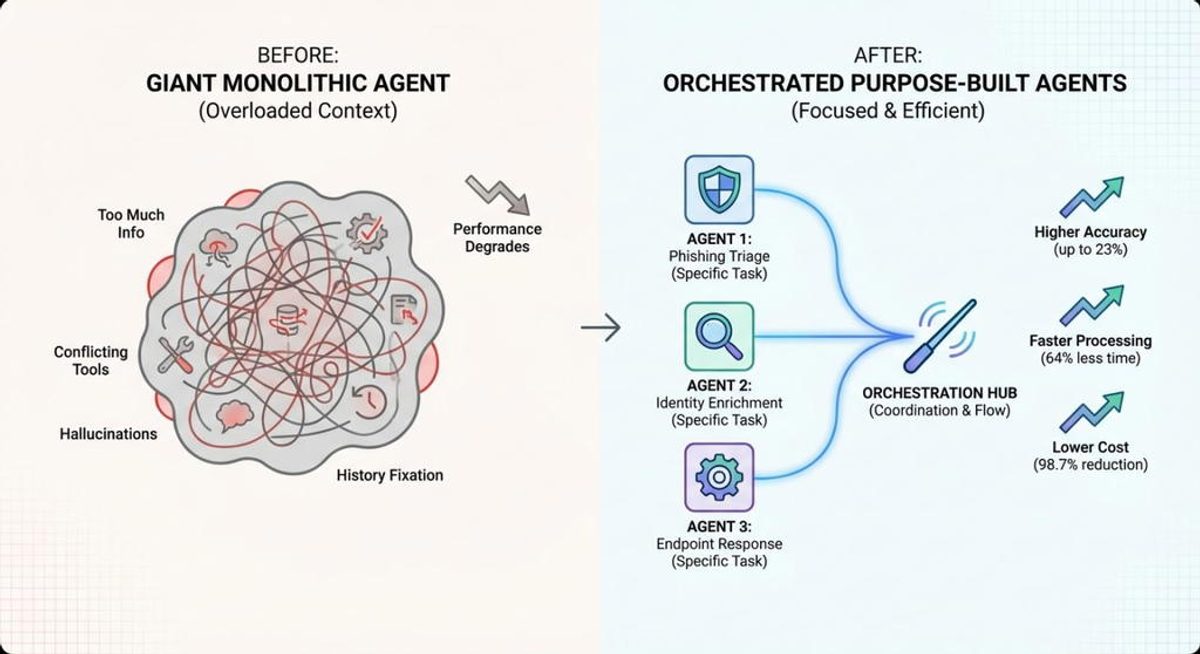
The "more context is better" myth is killing your AI agents (studies prove it!)
I have seen the same advice over and over again: give your agents more context, more tools, more information, and they will perform better.
Here is what actually happens when you overload an agent with context:
Research from Databricks tested over 2,000 RAG runs across 13 models. The findings were stark. Most models peak at just 16,000 to 32,000 tokens, despite claiming capacities of 200,000 or more. Beyond that sweet spot, performance does not plateau. It degrades.
Here are some issues you might run into:
1. Context poisoning. One hallucination gets embedded in context and becomes treated as fact for every subsequent reasoning step.
2. Context distraction. The model fixates on accumulated history instead of applying knowledge from training.
3. Context confusion. Early incorrect attempts remain in context and corrupt final outputs. Studies show performance drops up to 39 percent when information is gathered in stages.
4. Context clash. Tool definitions conflict with system prompts. Each additional MCP server exponentially increases contradiction probability.
NVIDIA's RULER benchmark found that models claiming 32,000 plus token contexts could only maintain satisfactory performance up to 32,000 tokens. Yi-34B, which supports 200,000 tokens, showed continuous performance decline as input length increased.
So what works?
Smaller, purpose built agents designed for specific tasks.
Microsoft's Phi-3 Mini at 3.8 billion parameters achieves competitive performance against models orders of magnitude larger on targeted tasks. CrowdStrike achieved 80 to 98.5 percent accuracy improvement by deploying specialized agents instead of general purpose analysis.
Instead of one massive agent handling phishing triage, identity enrichment, and endpoint response simultaneously, you build three focused agents. Each requires only 4,000 to 8,000 tokens of context. Each can be updated independently. Each fails in isolation without cascading through your entire workflow.
The results speak for themselves. Up to 23 percent higher accuracy on complex reasoning tasks. Processing times dropping by 64 percent through parallelization. Cost reductions up to 98.7 percent by eliminating unnecessary context.
To be clear though, context is good, and important! Just not too much context.